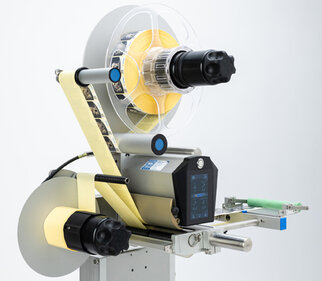
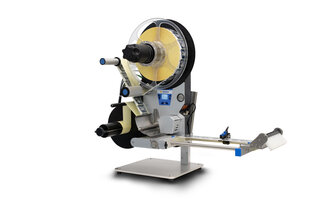
For machine builders, system integrators, and end users alike, integrating labelling technology is often one of the most demanding tasks in packaging and production lines. Different installation scenarios, speeds, control systems, and label formats require highly flexible solutions—while integration effort, lead times, and product complexity must be kept to a minimum. At Interpack 2026, HERMA will demonstrate how virtually all these requirements can be met with a single system—presented for the first time at a dedicated booth exclusively for applicators (Hall 8B, Booth C27). “This allows us to address machine builders, line integrators, general contractors, and automation providers even more effectively,” says Philipp Ott, Head of Sales Germany and OEM at HERMA labelling machines. The centerpiece of the presentation is the HERMA 500 applicator. With this focus, HERMA underscores its role as a technology partner for OEMs and a preferred implementation partner for end users.
Unmatched availability
The HERMA 500 is one of the most modular solutions of its kind. A powerful online configurator enables millions of customised variants—covering virtually any installation scenario, speed, or label width—while maintaining a consistent core unit and user interface. For machine builders and integrators, this level of standardisation ensures maximum planning reliability: integration processes remain consistent, while spare parts management and training requirements are reduced. At the same time, users benefit from high reliability and short lead times. Thanks to standardised assemblies and stocked components, customised versions are typically available within around ten days. “That’s practically unmatched,” Ott emphasizes. Another key advantage for OEM projects is seamless integration into higher-level control systems. The HERMA 500 supports industrial Ethernet standards such as Profinet and EtherNet/IP, enabling direct integration into widely used PLC systems. This significantly reduces wiring effort and associated costs.
Parameters can be defined online
A key tool for machine builders is the HERMA online configurator. It allows users to tailor the HERMA 500—including stand and ready-to-install configuration—precisely to project requirements. Parameters such as machine width, web direction, dispensing systems, and speed ranges can be defined individually. The corresponding CAD data is immediately available for download in multiple formats and can be directly integrated into machine or line designs. In addition, 3D drawings for visualisation and system integration can be generated automatically.
Cost-efficient solution, high-quality design
In addition to the HERMA 500, HERMA will present further applicators for a wide range of applications. These include the cost-efficient entry-level applicator HERMA eco for standard applications. It combines strong cost efficiency with high-quality design and can also be configured via the HERMA online configurator. For logistics labelling tasks, HERMA will as well present the print-and-apply system HERMA PA4. Its modular components—including print module, application unit, and winder—can be flexibly integrated into existing production lines. A semi-automatic wrap-around applicator HERMA 211, equipped with a printer from Elried, demonstrates solutions for smaller production environments or flexible applications. In addition, HERMA will present an application for labelling flow packs based on the HERMA 500 VFFS. This example illustrates how the modular applicator can be integrated into vertical or horizontal form-fill-seal machines. With this applicator-focused trade show presence, HERMA demonstrates how standardised, modular labelling technology can be flexibly integrated into a wide range of machine and line concepts. For machine builders, this means maximum design freedom combined with a high level of standardisation. End users benefit from fast availability despite virtually unlimited configuration options.